Your Aerobic Base Is Your Volume Ceiling - Paul Oneid
Your Aerobic Base Is Your Volume Ceiling
Your first two working sets of squats move well. By the fourth set, your rest periods have stretched from three minutes to five, your heart is still pounding when you unrack the bar, and the reps slow down long before your legs should be done.
By the time you get to accessories, you're going through the motions.
Most lifters read this as a strength problem or a programming problem. Add a set, swap an exercise, push harder next week. In many cases, the real limit is the system that refills you between sets, and you haven't trained it in years.
You’re just unfit and too out of shape to get stronger.
Where "cardio kills gains" came from
If you came up in strength training, you probably picked up this axiom early. The fear has a real basis. Researchers have shown since the early 1980s that stacking endurance work on top of lifting can blunt strength and size gains. It's called the interference effect.
The details matter, though. A 2012 meta-analysis by Wilson and colleagues pooled 21 studies to identify which parts of endurance training drive the problem. Running alongside lifting led to meaningful losses in strength and muscle. Cycling didn't. The more often people did cardio and the longer each session lasted, the bigger the interference. They also stacked the sessions close together and the durations and intensities involved were quite significant.
So the finding is about dose, timing and type. A few easy sessions a week on a bike, a rower, or an incline walk are at the low end of every variable that caused trouble in that research.
A real world example here is me. As most of you know, I’ve been running significant mileage and have run a 30km and a 50km trail race this year. Initially, as my mileage climbed, it was tough to train at the intensity required to get stronger. That said, I didn’t lose strength or muscle mass, even when running 40+ miles a week.
What your aerobic system does for your lifting
A heavy set burns through your fastest energy source, phosphocreatine, in seconds. Your aerobic system rebuilds that fuel while you rest. It also clears out the byproducts that make the next set feel worse than it should.
A 2001 Sports Medicine review by Tomlin and Wenger examined exactly this. Across the research, people with better aerobic fitness recovered faster between repeated hard efforts. They regenerated phosphocreatine faster, cleared lactate more efficiently, and maintained higher power output from one effort to the next. Most of that research used sprints rather than barbells, but the pattern is the same one you repeat every session: work hard, rest briefly, go again.
This is why your aerobic base sets your volume ceiling. Every program assumes you'll show up to set four in roughly the same shape as set one. If your engine can't refill the tank in the rest period you have, the extra sets you're doing become practice at being tired. The same applies across the week. Better recovery between sessions means more of your training days are actually productive.
Why I prescribed cardio to a powerlifter
One of the lifters I coach is heading into a short forced break. A health issue makes heavy barbell work painful right now, and he has a procedure coming up. When he's cleared, he'll have about 12 weeks before a major meet.
We pulled the heavy lifting and kept light isometric holds and slow-tempo machine work. Then I added something he didn't expect: easy cardio every day, with his heart rate sitting around 115-125 beat per minute.
The goal had nothing to do with burning calories. His prep block will be dense, with three heavy competition-lift days and three restorative days every week. Being able to handle that workload from the first week is what matters most. The easy aerobic work now is what lets him start strong instead of spending the first month just getting his conditioning back.
How to build the base without hurting your lifting
Keep it truly easy. You should be able to hold a full conversation. For most people, that's roughly 60 to 70% of max heart rate. If you're breathing hard, you've drifted into work that costs recovery instead of building it. You should be able to carry a conversation
Start with two or three sessions a week, 20 to 30 minutes each. That's enough to see a difference in how you recover between sets within a few weeks. Over time, I do suggest bringing that up to about 150 minutes total, spread across the week. This will benefit performance and your health.
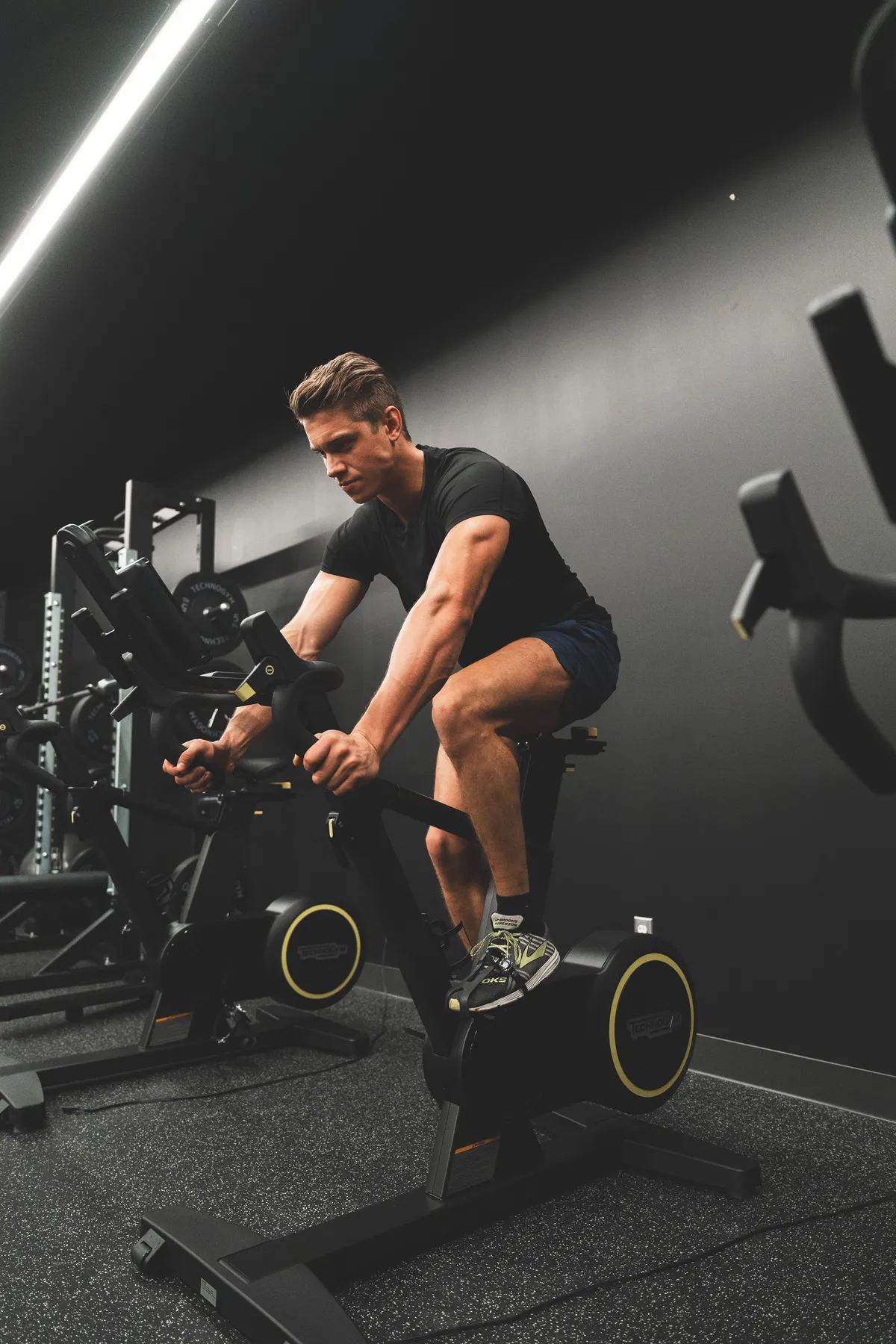
Pick the low-impact options. A bike, a rower, elliptical or an incline walk gives you the aerobic work without the pounding that running puts on legs that are also squatting. If you’re a weirdo and like the stairmaster, you can do that too, just be careful about fatigue in the legs.
Keep it away from heavy leg days. Do it after upper-body sessions, on off days, or several hours away from your lifting. Literally anything counts, as long as your heart rate is elevated within the desired range.
Find out what's actually limiting you
If your sessions fall apart in the second half, it's worth finding out whether the problem is your strength or your engine before you change anything else. That's one of the first things we look at in a consult. You can book one at masterathletic.com.